The Future of the Rose District: Inside Broken Arrow’s Downtown Master Plan
What could be next for Downtown Broken Arrow, from destination parks and activated alleyways to new housing, entertainment, redevelopment and a larger vision for downtown
Updated August 2026
Something interesting is happening in Downtown Broken Arrow.
And it is much bigger than another restaurant opening on Main Street.
Broken Arrow is working through a new Downtown Master Plan that asks what the next generation of the Rose District could look like. Some of the ideas being discussed are fairly small. Others could significantly change what people think of when they hear the words “Downtown Broken Arrow.”
A redesigned destination park.
Activated downtown alleyways.
More places to live near Main Street.
A market hall or food incubator.
A boutique hotel.
A town square.
A larger sports and entertainment district.
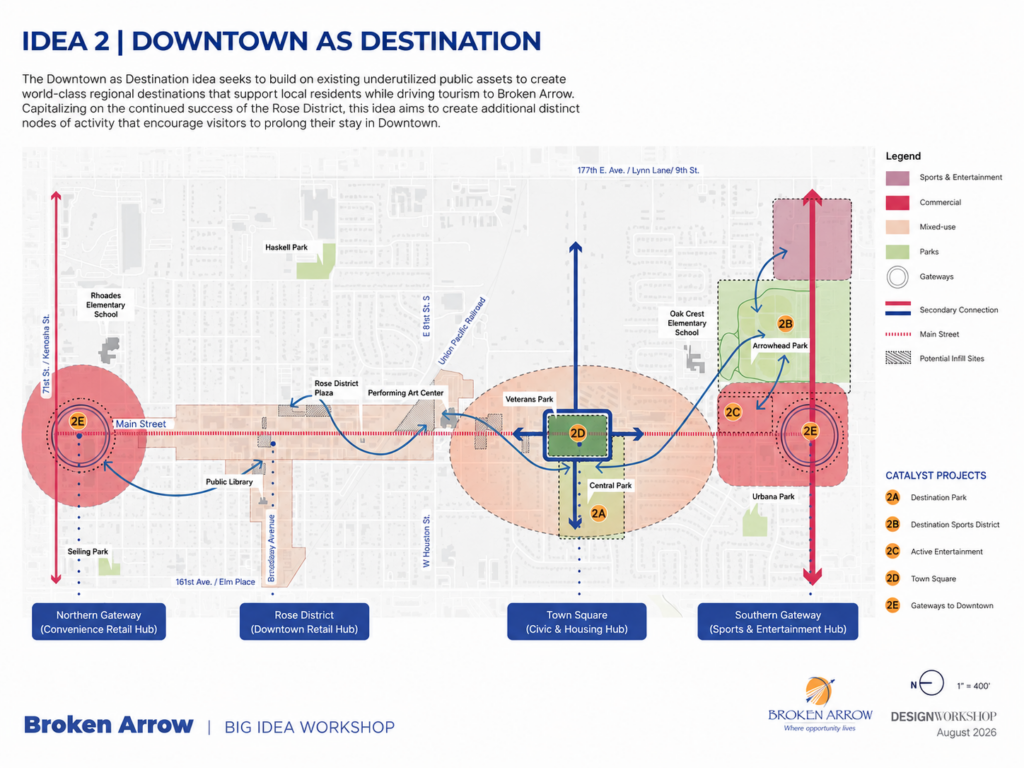
Better connections between Main Street, Central Park, Veterans Park and Arrowhead Park.
And potentially much more development throughout an area that extends well beyond the few blocks most people currently think of as the Rose District.
I serve on the Citizens Advisory Committee for Broken Arrow’s Downtown Master Plan, and I wanted to create one place where residents can understand what is being discussed, what caught my attention and, just as importantly, what is actually happening versus what is still simply an idea.
This page will change as the planning process moves forward.
A quick but important distinction: The concepts shown below came out of the master planning and brainstorming process. They are not a list of approved construction projects. Some could eventually become real projects. Some could change considerably. Some may never happen. I’ll try to keep that distinction clear throughout this page.
The Quick Version: What Is Broken Arrow Looking At?
If you don’t want to read the entire page, here is the big takeaway:
Broken Arrow is looking at Downtown as a much larger destination than Main Street alone.
The conversation is about building on what has already worked in the Rose District while creating additional reasons to live, work, visit and spend time throughout Downtown.
The ideas presented during the current planning process generally fit within three larger themes:
Culture of Enterprise
Building on local businesses, entrepreneurship, housing and development.
Downtown as a Destination
Creating major attractions and gathering places that give people more reasons to intentionally visit Downtown Broken Arrow.
The Green Connector
Making it easier and more enjoyable to move between Main Street, surrounding neighborhoods, parks, businesses and other destinations.
Those names sound like planning language.
What they could actually mean for Broken Arrow is much more interesting.
First: This Is Bigger Than the Rose District We Know Today
When most people say “Rose District,” they are talking about the restaurants, shops and activity concentrated along Main Street.
But one of my biggest takeaways from the planning process is that the future conversation is much larger geographically.
The question isn’t simply:
How do we extend the Rose District another block?
It is closer to:
How do we make all of Downtown Broken Arrow feel connected and give people multiple reasons to spend time here?
That could mean Main Street remains the heart of Downtown while other areas develop identities of their own.
Central Park could become more of a destination.
Veterans Park could play a larger civic role.
Arrowhead Park and the softball complex could become part of a broader sports and entertainment area.
Neighborhoods around Downtown could gradually add more housing.
Underused properties could become mixed use development.
Alleys and overlooked spaces could become destinations rather than just service areas.
That is a much more ambitious conversation than simply adding another storefront to Main Street.
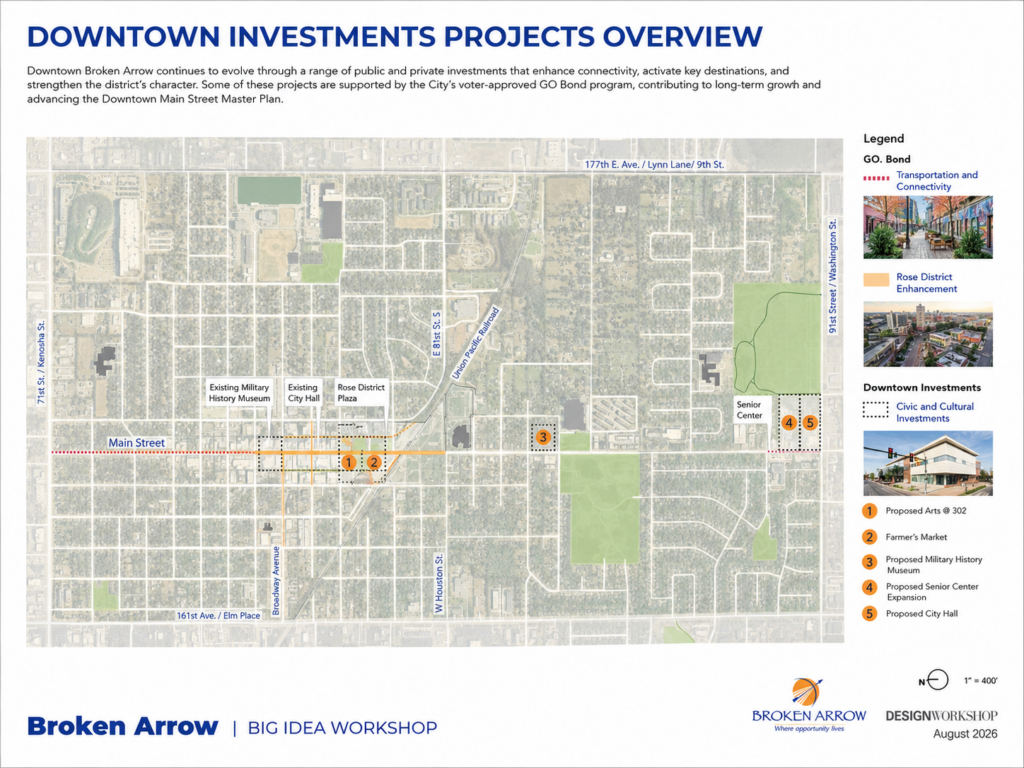
One of the maps presented during the Downtown Master Plan workshop showing how planners are looking beyond Main Street at the larger Downtown area. Concept material prepared by Design Workshop for the City of Broken Arrow. Photo by Corbett Campbell.
What Is Already Changing Downtown?
Before getting into the big ideas, there is an important reason I think this planning process matters right now:
Downtown already has several moving pieces.
This isn’t a conversation taking place in a vacuum.
City facilities are shifting farther south toward the Washington Street and Main Street area. The current City Hall is expected to eventually be replaced by a new municipal facility near that area, creating a major question about what happens with existing city property closer to the traditional Rose District.
There is also continued investment around the Senior Center area.
The Rose District Plaza and Farmers Market area has future investment planned as well.
That means buildings and properties that have had the same function for decades may eventually have completely different opportunities.
And when you combine those changes with the Downtown Master Plan, there is a lot of potential movement happening at roughly the same time.
For me, that is one of the most interesting parts of all of this.
It isn’t necessarily one giant project transforming Downtown overnight.
It is several different decisions creating opportunities for what comes next.
Big Idea #1: Make Downtown More of a Destination
Of the ideas discussed, this was probably the category I found most interesting.
The Rose District already works as a destination.
People come downtown for dinner.
They come for the Farmers Market.
They come for events.
They come to the Performing Arts Center.
They come to shop or spend an evening on Main Street.
The next question is:
How do you give somebody enough to do that Downtown becomes a half day, full day or even overnight destination?
That is where several of the more ambitious ideas come in.

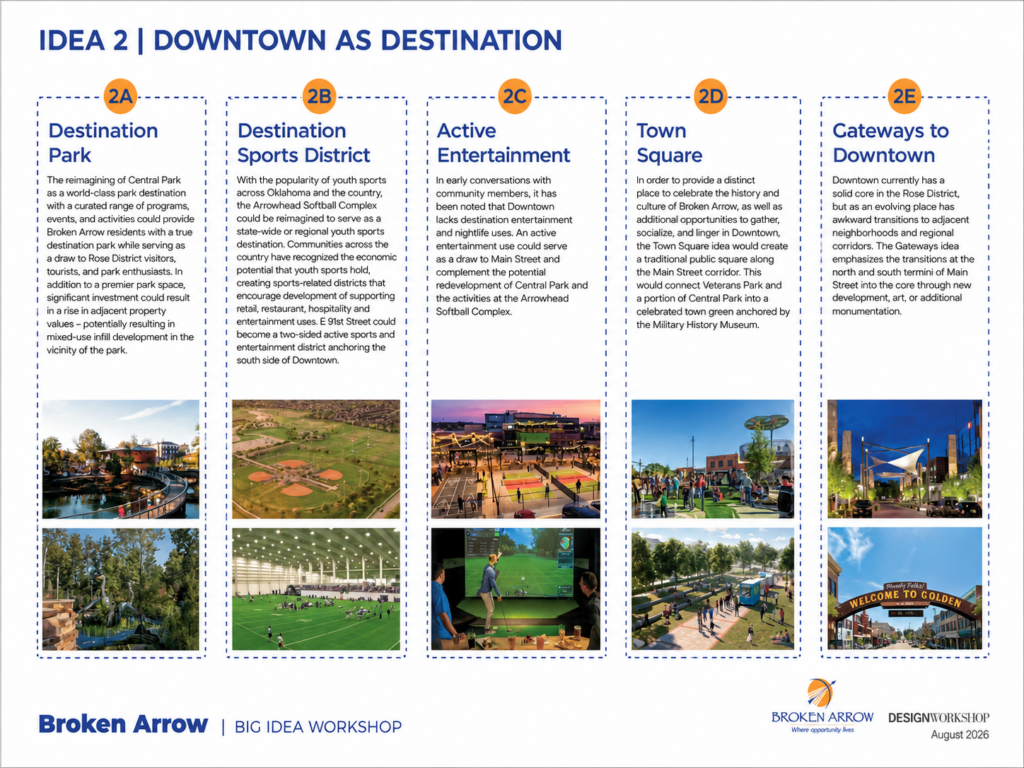
The “Downtown as a Destination” concept presented during the public master planning process.
A Redesigned Central Park Could Be a Big Deal
One of my personal favorite ideas was the concept of creating more of a destination park.
Central Park already has a valuable location, but there is a difference between a neighborhood or community park and a park that people intentionally travel across town to visit.
The planning conversation looked at how a park could become a stronger attraction in its own right.
That could mean a place where families spend a few hours rather than simply passing through.
It also becomes more important when you look at everything around it.
Central Park.
Veterans Park.
The Senior Center.
Arrowhead Park.
The softball complex.
Main Street just to the north.
If those places eventually become easier to move between and each gives people a different reason to visit, you start creating a much larger Downtown experience.
This is one of the ideas I personally think has a lot of potential.
Could Broken Arrow Have More of a True Town Square?
Another concept that caught my attention was the possibility of creating more of a Town Square environment.
Broken Arrow has Main Street, but it doesn’t really have the traditional courthouse square or central civic plaza that defines some older downtowns.
The planning concept looks at whether an existing Downtown public space could play more of that role.
Think community gathering space rather than simply another park.
A place for events.
A place to meet people.
A place that feels like a recognizable center of the community.
Whether the final master plan ultimately recommends exactly that remains to be seen, but I think the underlying idea is important:
Downtown should have places where you can be without necessarily having to buy something.
Those spaces make the restaurants, shops and businesses around them stronger too.
Arrowhead Park Could Become Part of a Larger Sports District
The Arrowhead Park area is another piece of Downtown that I think is easy to overlook if your mental picture of the Rose District ends around Main Street.
The planning concepts looked at the possibility of a larger Destination Sports District built around existing sports facilities.
That could create opportunities for entertainment, restaurants, recreation and other businesses that benefit from the traffic already coming into the area.
For families traveling for sports, there is a huge difference between:
Play the tournament and leave
and
Play the tournament, eat Downtown, explore the park, shop on Main Street and stay in Broken Arrow longer.
That connection between sports tourism and the rest of Downtown is what makes the concept interesting to me.
More Entertainment Could Help Fill the Gaps Between Destinations
Another theme was active entertainment.
This matters because Downtown currently has different activity levels depending on where you are and what time of day it is.
Main Street can be busy while areas only a few blocks away feel completely disconnected.
Adding entertainment uses between existing destinations could help fill those gaps.
One of the concepts presented elsewhere in the plan even includes an indoor and outdoor music venue.
That doesn’t mean a particular venue has been announced.
It means planners are asking whether entertainment uses like that belong in the long term Downtown mix.
Big Idea #2: Give People More Reasons to Live and Work Downtown
A successful downtown can’t run entirely on Friday night dinner traffic.
People living and working nearby create activity seven days a week.
That’s where the Culture of Enterprise concept becomes interesting.
This concept looks at entrepreneurship, housing, hospitality, small businesses and redevelopment together rather than treating each one separately.
An Entrepreneur Neighborhood
One idea is creating more of an entrepreneur neighborhood within Downtown.
Broken Arrow has plenty of people building businesses.
The question is whether Downtown can provide more places for some of those businesses to start, grow and operate.
That could mean smaller spaces, flexible working environments, shared resources and properties that don’t require a new business owner to immediately take on the cost of a major conventional storefront.
I like the concept because it adds another reason for people to be Downtown during the daytime.
The strongest downtowns aren’t only busy when people are eating dinner.
People work there.
People live there.
People start businesses there.
Then the restaurants and shops benefit from all of that activity.
A Market Hall or Food Incubator
One of the more interesting concepts on the board was a food incubator or market hall.
The basic idea is pretty easy to understand.
Starting a restaurant is expensive.
A smaller food concept may be good enough to succeed but not yet ready for the cost and risk of building a full restaurant.
A market hall or food incubator can create a lower barrier for those businesses to test concepts and grow.
It can also create a destination where several different vendors operate together.
For the Rose District, I think that concept makes a lot of sense because food is already such a major part of why people visit Downtown.
Instead of competing with that identity, it builds on it.
Could Downtown Broken Arrow Eventually Have a Boutique Hotel?
This may be one of the concepts that gets the most public attention.
A boutique hotel was included in the Culture of Enterprise discussion.
And I understand why.
The Rose District has become a place people travel to, but Downtown has a limited ability to capture an overnight visitor.
A hotel changes the economics of a visit.
Someone who stays Downtown may eat dinner there, attend an event, stay overnight, get breakfast or coffee the next morning and visit additional businesses before leaving.
That’s a very different visitor than someone who drives in for an hour and a half and heads home.
I also think the word boutique matters.
The concept isn’t simply “put a giant hotel in the middle of Main Street.”
The interesting question is whether hospitality could be developed in a way that actually fits the character people like about the Rose District.
Again, there is no reason to read this concept as an announcement that a specific hotel is coming.
But the fact that hospitality is part of the conversation tells you something about how planners are thinking about Downtown’s future.
More Housing Could Quietly Be One of the Biggest Changes
Restaurants and entertainment will probably get more attention.
Housing may ultimately matter more.
One of the concepts presented was owner driven residential infill.
That means looking at ways the neighborhoods surrounding Downtown could gradually accommodate more people without necessarily bulldozing entire blocks and replacing them with giant apartment buildings.
That might include things like accessory dwelling units, additional homes on larger properties, duplexes or other relatively small scale housing.
There are also broader mixed use infill opportunities included elsewhere in the planning concepts.
Mixed use can be as simple as:
Business downstairs.
Housing upstairs.
That is the kind of development pattern you see in a lot of walkable downtowns.
And from a development standpoint, adding residents near Main Street changes the customer base for everything around them.
A coffee shop doesn’t only depend on someone driving across Broken Arrow.
A restaurant has customers living a few blocks away.
People can walk to events.
Downtown has activity even when there isn’t a major event happening.
Housing isn’t the flashiest part of a master plan, but it can be one of the things that makes everything else work.
One of My Favorite Ideas: Bring the Alleyways to Life
This one sounds simple, but I really liked it.
Activated alleyways.
Right now, most alleys are exactly what you would expect.
Back doors.
Dumpsters.
Deliveries.
Utility access.
Nothing wrong with that. They serve a purpose.
But in a downtown, those spaces can sometimes become something completely different.
Lighting.
Murals.
Patios.
Outdoor dining.
Small events.
Pedestrian passages.
Public art.
Little spaces that have an identity of their own.
I like this idea because it doesn’t require Downtown to keep expanding outward in order to create something new.
It asks:
What spaces do we already have that we’re barely using?
That’s the kind of thinking I would love to see more of around the Rose District.
Big Idea #3: Connect Everything Together
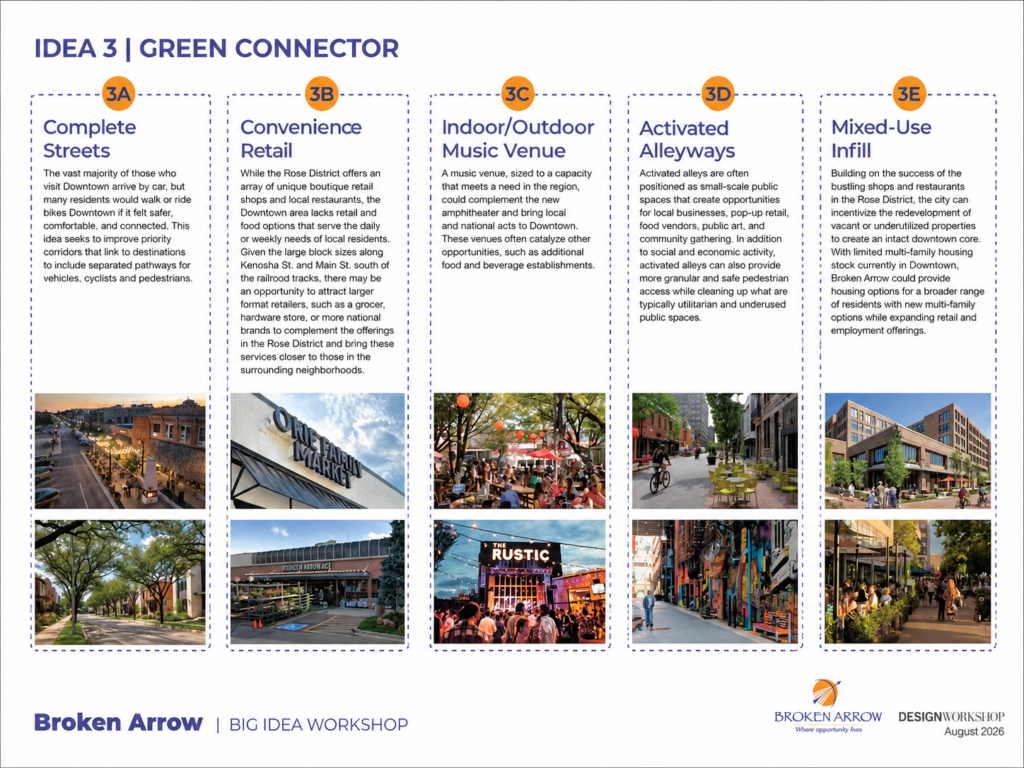
The third larger concept is called the Green Connector.
At first glance, this probably isn’t the concept that gets people the most excited.
Once you look at the map, though, it becomes pretty important.
If Downtown keeps adding destinations but every destination requires you to get back into your truck and drive three blocks, you don’t really have one downtown.
You have several nearby places.
The Green Connector concept looks at how streets, sidewalks, trails, landscaping and development could make those places feel connected.
Main Street.
Nearby neighborhoods.
Central Park.
Veterans Park.
Arrowhead Park.
Businesses.
Entertainment.
Housing.
Instead of each being an island, the goal is to create a network.
Better Streets Aren’t Just About Cars
One of the concepts is Complete Streets.
The basic point is that a downtown street has more than one job.
Yes, it has to move vehicles.
But it may also need to work for someone walking to dinner.
A parent pushing a stroller.
Someone riding a bike.
A business trying to create outdoor activity.
Someone crossing from a parking area.
That can mean better sidewalks, safer crossings, lighting, trees, landscaping and other improvements depending on the street.
You don’t need every Downtown street to look exactly the same.
You do need to be able to move through Downtown without feeling like every trip requires a vehicle.
What I Think the Bigger Story Is
After sitting through the discussion and looking through all of these concepts, my biggest takeaway wasn’t one rendering or one proposed project.
It was how much passion there is around the future of Downtown Broken Arrow.
The room wasn’t made up of one type of person.
There were people from Design Workshop.
People connected with the City and economic development.
Broken Arrow Chamber involvement.
Local business owners.
Commercial developers.
People from local nonprofits.
People connected to the Community Playhouse.
Realtors, including myself.
And people looking at Downtown from very different perspectives.
That matters.
A restaurant owner looks at Downtown differently than a developer.
A nonprofit sees different needs than a City employee.
Someone involved with the Community Playhouse understandably looks differently at a property that could potentially be affected by redevelopment.
A resident may care more about parks or walkability.
A developer may immediately notice an underused property and wonder what else could happen there.
There was a lot of conversation around one general idea:
How do we make Downtown itself an attraction?
Not just one restaurant.
Not just one event.
Not just one park.
Downtown.
Why the Timing Is So Interesting
This may be the piece I am personally watching closest.
There are already major changes happening or being discussed around Downtown.
City Hall functions are expected to shift south toward Washington Street and Main Street.
There is significant investment around the Senior Center.
The Rose District Plaza and Farmers Market area has new investment coming.
And that means some properties that currently have established civic uses could eventually have new possibilities.
The existing City Hall property is one obvious example.
There is also discussion around other longstanding Downtown buildings and uses, including the Community Playhouse area.
I want to be very careful here:
Discussion does not equal a decision.
The master planning process is specifically the time when possibilities are supposed to be discussed.
But that’s also why the next few years could be unusually interesting for Downtown Broken Arrow.
The City isn’t looking at a completely blank sheet of paper.
It is looking at a downtown where several pieces may already be moving.
My Favorite Ideas So Far
If I had to pick the concepts that stood out most to me personally, I would put these near the top:
1. Making Downtown a Destination
This is the biggest one.
I think the Rose District has already proven that people will intentionally come to Downtown Broken Arrow.
The opportunity now is to give them more reasons to stay longer and explore farther.
2. A Destination Park
I think a really strong park can be an economic development tool just as much as a quality of life investment.
Done correctly, it creates activity that spills into nearby businesses and makes the surrounding area more attractive for future development.
3. Activated Alleyways
This is probably the smallest idea on my list, which is part of why I like it.
Not every good Downtown improvement needs to cost tens of millions of dollars.
Sometimes you can create an interesting place out of space that already exists.
4. Better Connections Between Everything
The Rose District becomes much more powerful if people naturally move between Main Street and the parks, entertainment, housing and businesses around it.
The individual projects matter.
The connections between them may matter just as much.
What Is Actually Approved?
This is probably the most important question on this entire page.
As of August 2026, the master plan concepts themselves should be viewed as ideas being studied and refined, not as a construction announcement.
The current stage is about brainstorming, public input and developing recommendations before a final vision is presented to the City.
So if you see:
Boutique hotel
That does not mean a hotel has been approved.
If you see:
Music venue
That does not mean a venue has been announced.
If you see:
Town Square
That does not mean construction starts next year.
If you see:
Destination Sports District
That does not mean Arrowhead Park has an approved redevelopment plan matching the concept board.
The point of this stage is to think bigger first.
Then the ideas have to meet reality.
Cost.
Infrastructure.
Public support.
Private investment.
City priorities.
Engineering.
Funding.
Market demand.
And probably a dozen other things.
Some ideas will get stronger as the process continues.
Some will change.
Some may disappear.
That’s normal.
What Happens Next?
The concepts shown on this page are part of the brainstorming and public input stage of the Downtown Master Plan.
The next important step is turning that broad discussion into a more defined plan that can ultimately be presented to the City.
That’s when things get more interesting.
Which ideas keep showing up?
Which locations make sense?
Which concepts have strong public support?
Which ones are realistic?
What should happen first?
What belongs in a five year vision versus a twenty year vision?
And where should private development take the lead instead of the City?
I plan to keep updating this page as those answers become clearer.
Frequently Asked Questions About the Rose District Master Plan
Is Broken Arrow expanding the Rose District?
The current Downtown Master Plan is looking at an area larger than the traditional Main Street Rose District and exploring ways to better connect existing Downtown destinations with future development. That does not necessarily mean the Rose District branding itself will simply be extended across the entire area.
Is Broken Arrow building a boutique hotel in the Rose District?
A boutique hotel is one of the concepts being considered in the Downtown Master Plan process. As of August 2026, the concept should not be interpreted as an announced or approved hotel development.
Is Central Park going to be redesigned?
A destination park is one of the larger ideas being explored through the planning process. The final form, funding and timing of any future Central Park improvements would depend on what ultimately moves beyond the concept stage.
Is Broken Arrow planning a Town Square?
A Town Square concept was presented as part of the Downtown as a Destination idea. It remains a planning concept rather than an announced construction project.
Is Broken Arrow considering more housing Downtown?
Yes. Housing appears in several of the concepts being explored, including owner driven residential infill and mixed use development.
What does activated alleyway mean?
It means taking alley spaces that are normally used only for deliveries, utilities and back of building access and finding ways to make at least some of them useful public spaces through features such as lighting, patios, art, pedestrian connections or events.
Is a music venue planned for Downtown Broken Arrow?
An indoor/outdoor music venue appears among the potential uses explored in the current master planning concepts. That does not mean a specific venue has been approved or announced.
What is the Green Connector?
The Green Connector is one of the three major ideas presented during the master planning process. In simple terms, it looks at how Downtown streets, sidewalks, public spaces, development and pedestrian connections could better link Main Street with surrounding neighborhoods, parks and destinations.
Who is working on the Downtown Master Plan?
The process includes the City of Broken Arrow, its consulting team, the Citizens Advisory Committee, community stakeholders and public input.
Are residents able to participate?
Yes. Public input is part of the master planning process. The concepts shown here were presented during the public workshop process so residents could review ideas and provide feedback.
My Takeaway
I grew up around Broken Arrow, and one thing I think our city sometimes undersells is just how much change has happened here in a relatively short period of time.
The Rose District itself is proof of that.
There was a time when the Main Street we have today was just an idea people were trying to build toward.
That’s why I think this master planning process is worth paying attention to even if many of the concepts on these boards never happen exactly as drawn.
The important question isn’t whether every rendering becomes reality.
It is:
What does Broken Arrow want Downtown to become over the next 10, 20 or 30 years?
Right now there seems to be real energy around making it more than a few successful blocks of Main Street.
More places to gather.
More places to live.
More businesses.
More entertainment.
Better parks.
Better connections.
And a Downtown that becomes an attraction in its own right.
As a member of the Citizens Advisory Committee, I’m looking forward to seeing which ideas move forward and what the final plan ultimately looks like.
I’ll continue updating this page as the process develops.
About Corbett Campbell
I’m Corbett Campbell, a Broken Arrow real estate agent focused heavily on land, development and acreage throughout the area.
I also serve on the Citizens Advisory Committee for Broken Arrow’s Downtown Master Plan and stay involved in the conversations surrounding the future growth and development of the community.
I created this page because I think people in Broken Arrow should be able to understand what is happening Downtown without having to dig through meeting notices, planning documents and social media posts to piece it together.
If you’re interested in Broken Arrow, the Rose District, local development or land around the area, you’ll find more of my local information and community involvement throughout this website.
This page was last updated in August 2026 and will be updated as the Downtown Master Plan moves forward.
Planning board images shown on this page were photographed during the public Downtown Master Plan process. Concept materials shown in the photographs were prepared by Design Workshop for the City of Broken Arrow.