
Oklahoma Buy Land · Land buyer resources
How to check utility easements on land in Oklahoma.
Not all utility easements are bad. But all are worth understanding before you buy, build, or split a property.
Learn what to look for on the land, what to review in the paperwork, and which questions to ask before closing.
Start with the whole picture
Beautiful land still deserves a closer look.
A property may have good access, beautiful views, and plenty of acreage. Utility easements can still influence where you put a home, shop, fence, driveway, or future development.
That does not automatically make it a bad property. The goal is to understand where the easement is, what rights it grants, and whether it works with your plans.
As an Oklahoma land real estate agent, I encourage buyers to investigate these details early—especially on rural acreage, development land, and properties near major infrastructure corridors.
Explore my complete Oklahoma land buying guide →A practical starting checklist
- Review the paperwork. Ask the title company for the easement documents referenced in the title commitment.
- Review the survey. Ask a licensed surveyor to help identify the easement’s location and how it relates to your intended improvements.
- Walk the property. Look for markers, poles, cleared corridors, and utility equipment.
- Contact the provider. Ask about access needs, restrictions, and whether service to your property is actually available.
- Compare it with your plans. Resolve questions with the appropriate professionals before closing.
Three different questions: Where is the utility? Where does the easement apply? Can the utility serve your property? Answering one does not automatically answer the others.
The basics
What is a utility easement?
A utility easement gives a utility provider certain rights to use or access land for infrastructure. Those rights may cover installation, maintenance, repairs, inspection, or other work described in the easement.
Utilities and related easements may involve:
- Electric lines and transmission corridors
- Natural gas and other pipelines
- Water and sewer lines
- Fiber internet and communications equipment
- Drainage infrastructure
Some are easy to notice. Others only become apparent when you review the survey, title commitment, and underlying documents. The actual terms matter more than a general description in a listing.
Get out and walk the property
How to physically spot possible utility easements.
A long cleared strip through timber may indicate a pipeline or transmission corridor. Power poles, towers, transformers, utility boxes, warning signs, painted markings, and maintenance roads can also provide clues.
These features are a reason to investigate, not proof of the easement’s exact location or width. A buried line may also be present where there is no obvious surface evidence.
Oklahoma Natural Gas explains that pipeline rights-of-way need to remain accessible for operation, inspection, maintenance, and repairs. Ask the provider before planning improvements in or near a corridor.
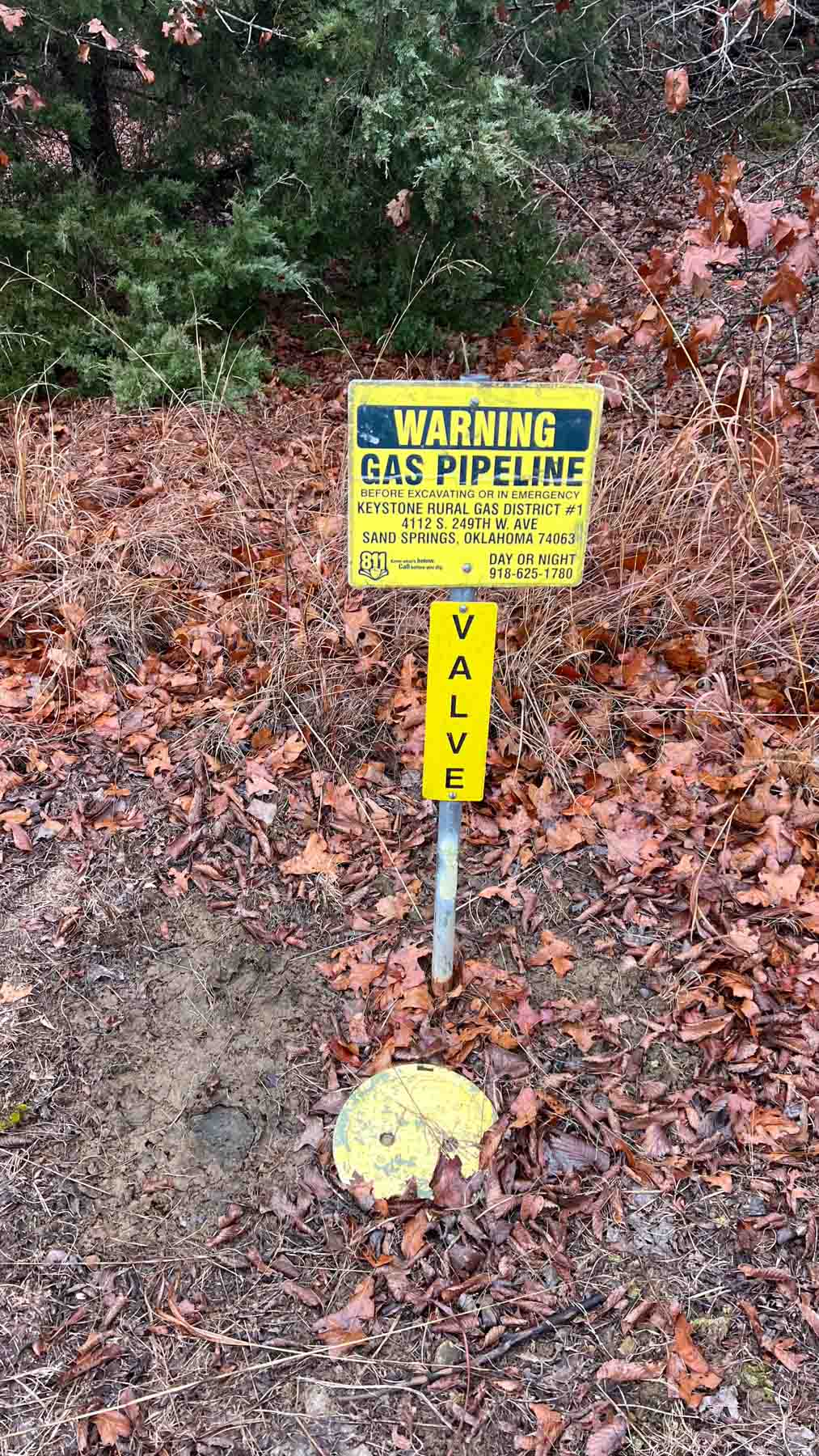
Use the land and the paperwork together. Visible infrastructure helps you ask better questions. It does not replace title review, a survey, or confirmation from the utility provider.
Put it in perspective
Utility easements are common in Oklahoma.
Many properties have utility easements along road frontage, subdivision entrances, or established corridors. Some have little practical effect on a buyer’s plans. Others deserve closer attention.
An easement near the edge of a property may be easier to plan around than a large corridor crossing a proposed homesite. Location, width, terms, and your intended use all matter.
Follow the clues
How buyers usually discover easements.
Buyers often first notice them on surveys, in title commitments, on aerial imagery, or while walking the land. County GIS maps can be useful starting points, too.
Maps and listing photos do not tell the entire story. I encourage buyers to walk larger tracts and then compare what they see with the documents and professional guidance.
A quick field reference
What do utility flag colors mean?
Paint and flags commonly identify utilities during locating work. The color gives you a clue about the type of facility being marked.
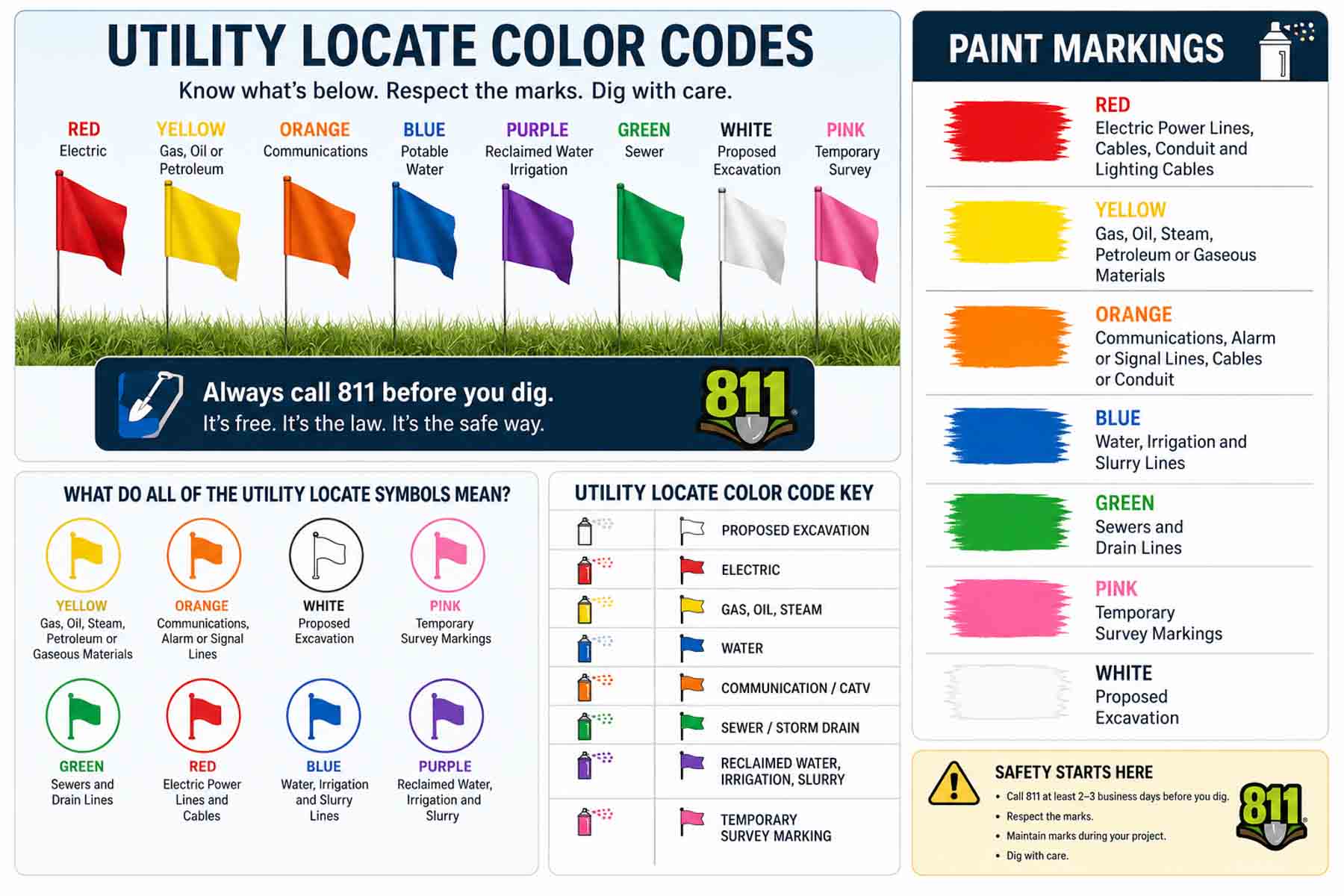
Flags are not easement boundaries. They also do not establish property lines or guarantee utility availability. Before digging, contact OKIE811 and follow the current locate process.
| Color | Common meaning |
|---|---|
| Red | Electric power |
| Yellow | Gas, oil, steam, and petroleum |
| Orange | Communications, telephone, and cable |
| Blue | Potable water |
| Green | Sewer and drain lines |
| Purple | Reclaimed water and irrigation |
| Pink | Temporary survey markings |
| White | Proposed excavation |
Reference: OKIE811 Excavator Guide — Uniform Color Code .
A real experience near Tulsa
Not every easement is a problem.
Sometimes the best next step is simply finding out what you are looking at.
I once worked with a buyer looking at roughly 40 acres near Tulsa. We noticed marked activity along the frontage, and the buyer was concerned that it might be oil-related activity affecting the land.
After investigating, we confirmed that it was a natural gas utility line along the road frontage. In that situation, it improved future utility accessibility and became a valuable feature for the tract.
That experience is a good reminder to investigate before making assumptions. A nearby line does not automatically mean another property can connect—service availability still needs to be confirmed directly with the provider.
Think beyond the purchase
How will the easement fit your plans?
The same easement can affect two buyers very differently. Start with what you actually want to do with the property.
01 · Homes and improvements
Where will you build?
Compare the easement with possible locations for a house, shop, barn, septic system, or pond. Understand restrictions before committing to a layout.
02 · Access and upkeep
What needs to stay accessible?
Ask about utility maintenance access and how fences, gates, driveways, landscaping, or other improvements could affect the corridor.
03 · Future use
Could your plans change?
A corridor may have little effect on your current use but become more important if you later split the property or pursue development.
Broken Arrow · Tulsa · Northeast Oklahoma
Development and lot splits deserve an earlier look.
On development property, utility easements are part of the bigger picture: lot layout, access, utility extensions, drainage, and the space available for improvements.
A corridor through the middle of a proposed project may influence lot design. Existing infrastructure near the frontage may offer opportunities, but capacity and connection requirements still need to be verified.
My background in the Broken Arrow and Tulsa area includes land development and lot splits, with experience working through Tulsa County planning, INCOG, the City of Broken Arrow, and Wagoner County.
I like getting the right questions in front of the right people early. Depending on the property and project, that may mean conversations with the utility provider, planning staff, a surveyor, an engineer, or the title company.
New utility extensions may also require additional easements. Confirm project-specific requirements before treating a concept drawing as a workable development plan.
Let’s talk about your property and plans →My approach
What I usually look for first.
- Surveys and title documents What is identified, and what needs a closer explanation?
- Aerial imagery and county mapping Where are the visible corridors and nearby utility features?
- The property itself What becomes clearer when we walk it?
- Your intended use Does the information fit where and how you want to build or use the land?
The goal is to connect what the documents say with what is happening on the ground.
Avoid the assumptions
Common mistakes buyers make.
- Assuming every easement makes a property undesirable.
- Skipping the survey or ignoring title exceptions.
- Confusing a utility easement with legal access for the owner.
- Assuming a nearby utility line guarantees a connection.
- Treating flags or online maps as exact easement boundaries.
- Waiting until late in due diligence to ask questions.
Investigating early gives you more time to understand the answers and decide whether the property fits your goals.
One final reminder
Understand the property before you close.
Utility easements are a normal part of many Oklahoma properties. Some have very little practical impact. Others can significantly affect future plans.
Review the survey, title work, utility information, and the land itself together. Ask questions while you still have time to investigate.
This guide provides general educational information. Confirm easement rights, locations, restrictions, and service availability with the title company, licensed surveyor, utility provider, municipality, or attorney as appropriate for your property.
Keep researching
More answers for Oklahoma land buyers.
- The complete Oklahoma land buying guide
- Confirming legal access
- Checking rural water availability
- Checking electric availability
- Confirming utilities before you buy
- Understanding whether land is buildable
- Checking septic and sewer availability
- Checking internet and cell service
- Gas and propane availability
- Oklahoma Water Resources Board